
For many newcomers, approaching a compressed Pu-erh tea cake (Bingcha) can be daunting. If you are looking to start your collection, browse our curated selection of fine Pu-erh tea cakes today. The goal of prying the tea is simple: to safely and easily separate the compressed leaves while keeping the integrity of the tea leaf whole as much as possible.
This post, based on years of real-world tea experience, shares an innovative, low-effort technique that focuses on the physics of the common tea cake for clean, high-efficiency separation.
Essential Principles for Prying Pu Erh
The foundation of safely breaking up a tea cake rests on three pillars: Safety, Integrity, and Efficiency.
The Right Tool for the Job
- A high-quality steel tea pick (chá zhuī) is sufficient for almost all types of tightly compressed Pu-erh.
- A tea knife (chá dāo) is generally only useful for very loosely pressed cakes (which can sometimes be broken by hand anyway).
- Crucial Tip: The tool should be steel, not iron, for durability and cleanliness.
Safety and Technique
- Avoid common prying methods (such as prying from the outer edge or the center depression), as these can increase the risk of injury and severely damage the leaf structure.
- Focus on separation: The action should be a smooth prying or separating motion, working with the compressed layers, not against them.
The High-Efficiency “Dimple Press” Technique
Our specialized method cleverly utilizes the shape of the widely available tea cake format.
A tea cake is characterized by a slightly domed surface and, when inverted, a noticeable concave curve or “dimple” on the back, formed by the pressing mold. This technique leverages that curve for easy, clean separation.
Step-by-Step Breakdown:
🟢 Step 1: Prepare the Workspace
- Unwrap the outer packaging paper of the tea cake.
- Place the unwrapped cake on a flat, stable surface.
- Important: Keep the original paper spread out on the surface. Its large area will easily catch any loose leaves or fragments, ensuring no tea is wasted.
🟢 Step 2: Invert and Apply Pressure

- Invert the tea cake so the prominent, concave curve (the back side, or “dimple”) is facing upwards.
- Place your hands flat on the left and right edges of the cake’s back.
- Keeping your arms straight, shift your body weight forward, applying controlled downward pressure to both ends simultaneously.
🟢 Step 3: Utilize the Cake’s Structure
- By relying on the opposing pressure from your hands and the natural high point of the curved cake, the tea cake will effortlessly crack and separate into two or more large, manageable pieces.
🟢 Step 4: Prying the Segments

- Once the initial split is made, the cross-sections are exposed. These natural break points allow you to easily insert your tea pick or knife into the seam.
- Gently pry or wiggle the tool to separate the compressed layers into smaller chunks. The pre-cracked structure makes this stage significantly easier than prying the intact surface.
🟢 Step 5: Preserve Leaf Integrity
- When dealing with large, separated blocks, do not break them apart by snapping (like a chocolate bar).
- Instead, use both hands to gently pull the block apart sideways. This simple pulling motion helps to preserve the entirety of the leaf strands, resulting in fewer broken bits and a better-tasting cup.
Storage and Daily Use Tips

Maximizing the flavor of your Pu-erh involves smart preparation and storage—you should rarely break up the entire cake into loose leaf at once.
- Daily Consumption: Pry the cake into medium-sized chunks. Only separate a single brewing portion into loose leaf immediately before you use it. This method allows the small, separated portion to “wake up” (xing cha) while preventing the rest of the cake from being over-exposed, preserving its aging character.
- Storage Container: Store the newly broken chunks in your everyday container. You have two excellent options:
- Paper-Based Boxes: A simple card stock/paper box strikes a perfect balance between breathability and enclosure, which is vital for Pu-erh’s slow aging process.
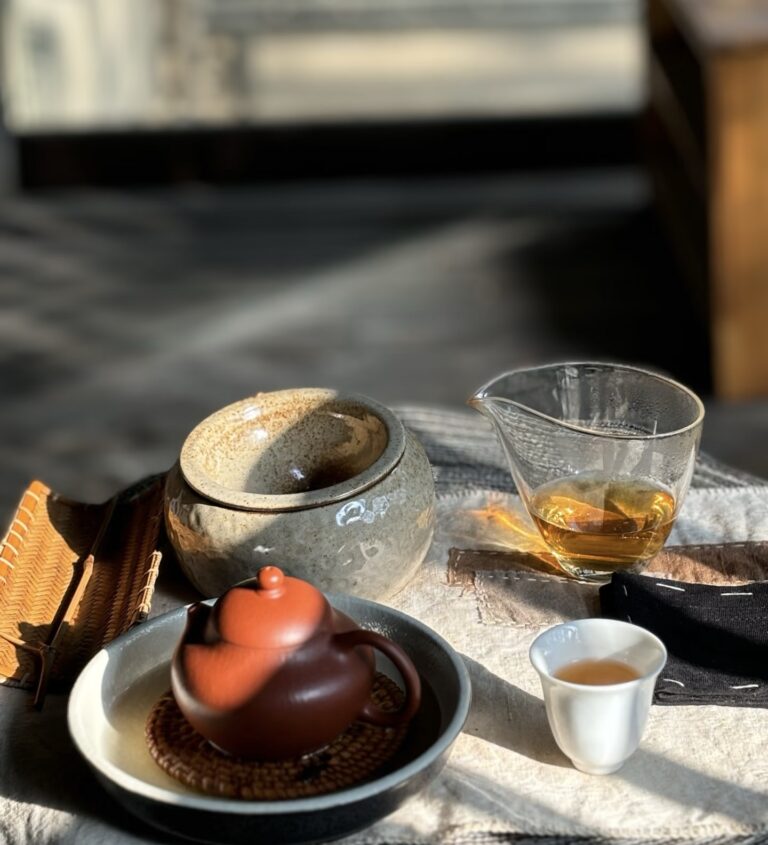
- Ceramic Tea Caddies: For smaller, regularly consumed quantities or premium batches, consider using a specialized tea caddy. A beautiful handcrafted piece, like the Grass Wood Ash Handmade Swirl Tea Caddy, not only offers excellent protection and a stable environment but also adds an element of ritual and elegance to your tea setup.
- Organization: Note the tea name on the side of the container. This maximizes the use of common storage spaces (like bookshelves) and allows for quick identification.
Conclusion
Learning how to properly break up a Pu-erh tea cake is a crucial skill that transforms the experience from a struggle into an enjoyable ritual. By adopting the high-efficiency “Dimple Press” technique, you not only ensure your own safety but also maximize the integrity of the valuable leaf material. This combination of whole-leaf structure and measured storage (whether in breathable boxes or specialized caddies) will significantly enhance the flavor profile and aging potential of every brew. Start practicing this technique today to unlock the full depth and complexity of your current collection, or find your next favorite Pu-erh tea on our chinese tea shop.