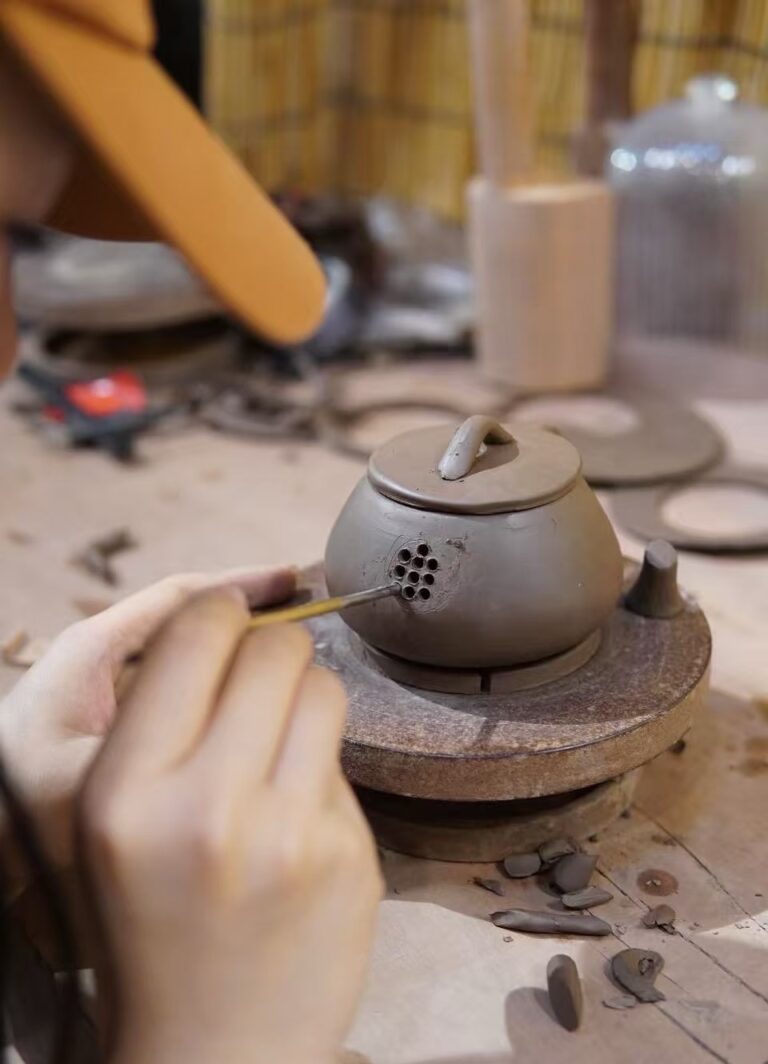

How a Yixing teapot is fired does matter, but usually not in the exaggerated way people talk about online. For most buyers, the real question is not whether a kiln sounds more romantic. It is whether the firing helped preserve the clay’s character, kept the surface clean, and produced a stable, well-finished teapot.
If you spend enough time around Yixing discussions, you will hear strong claims about dragon kilns, wood-fired teapots, electric kilns, reduction atmosphere, and old-style firing. Some of those ideas have a real technical basis. Some are collector preferences. Some are just marketing language. The useful part is learning what firing can actually change, and what it cannot.
What Firing Changes in a Yixing Teapot
Firing is one of the last major stages that shapes how a Yixing teapot looks and feels. It can influence color stability, surface cleanliness, small marks on the body, and how consistently the clay presents after finishing. That does not mean the kiln alone determines quality. Clay selection, processing, forming, trimming, lid fit, and overall workmanship still matter more than a dramatic kiln story by itself.
In practical terms, firing changes three things buyers notice most:
- Surface character: whether the teapot looks clean and even, or shows marks, spots, ash effects, or irregular firing traces.
- Color result: whether the clay fires in a stable and expected direction, or shows more variation because of the atmosphere and temperature conditions.
- Consistency: whether the finished teapot looks controlled and deliberate, or influenced by more variables inside the kiln.
If you are still early in the category, start with the broader guide on what a Yixing teapot is. If you already know you want one and are comparing options, the next practical step is the guide on how to choose a Yixing teapot.
A Short History of How Yixing Teapots Were Fired
Yixing has never been only about purple clay. Over time, the region has fired many ceramic types, and that means many kiln forms existed across different periods. For Yixing teapots specifically, the broad story is simpler than the local ceramic history as a whole.
At a high level, Yixing teapot firing moved through three major phases. Early firing relied on older kilns such as dragon kilns, where atmosphere and flame contact created more uncertainty inside the chamber. Later, enclosed sagger firing helped protect the teapot from direct interference inside the kiln. In the modern era, tunnel kilns, shuttle kilns, gas kilns, and electric kilns brought much tighter control over temperature, cleanliness, and repeatability.
This matters because many modern arguments about firing still come from these older transitions. People often treat visible marks or kiln drama as proof of superiority. Historically, though, a large part of firing development moved in the opposite direction: toward cleaner, more stable, less interrupted results.
Dragon Kilns and Earlier Firing Conditions
Older dragon-kiln firing carries a strong aura in collector culture, and not without reason. Dragon kilns belong to an earlier technical world in which flame movement, airflow, fuel loading, and position inside the kiln could create more variation. That variation could leave visible marks, local color differences, and firing irregularities on the body of a teapot.
Some collectors appreciate those traces because they connect the piece to an older firing logic. But that does not automatically mean those traces are desirable for every Yixing teapot. If your goal is to appreciate line, clay texture, form, and the overall unity of a teapot, too much interference from the kiln can become a distraction rather than an advantage.
Why Saggers Mattered So Much
One of the most important improvements in Yixing firing history was the use of protective enclosed firing containers, often discussed through the role of saggers. The basic idea is simple: protect the teapot from direct flame, stray glaze, ash, and other kiln contaminants so the clay can fire with fewer disturbances.
That technical change helps explain an important aesthetic point. A cleaner-fired Yixing teapot makes it easier to focus on the clay itself, the transitions in the body, the proportions, the handle and spout relationship, and the clarity of the maker’s work. In other words, improved firing was not just about higher yield. It also supported a more controlled and coherent finished object.
Modern Kilns: Tunnel, Shuttle, Gas, and Electric
Modern kiln systems changed the conversation again. Once tunnel kilns, shuttle kilns, and other more controllable modern kilns became common, temperature stability improved, the chamber became cleaner, and many of the older variables became easier to reduce. For Yixing teapots, that usually means more predictable color, fewer random marks, and a cleaner surface overall.
This is one reason modern kiln firing should not be dismissed as less authentic. If a teapot is meant to show the natural character of the clay rather than dramatic kiln interaction, a more stable firing environment can be exactly what you want.
Electric kilns are especially misunderstood. Some buyers assume electric firing is automatically inferior because it sounds too modern or too clinical. In reality, electric kilns can deliver highly precise and consistent firing. A new kiln or a poorly managed setup may leave temporary odor issues or other minor practical concerns, but that is not the same as saying electric kilns produce lower-level Yixing by definition.
What Wood-Fired Yixing Actually Changes
Wood-fired Yixing teapots attract attention because they promise drama. Buyers imagine old kilns, flame contact, ash effects, and a more “alive” surface. Sometimes that produces interesting results. But it also introduces more interference, and interference is not always a benefit for Yixing.
In practical terms, people usually talk about three possible wood-firing effects:
- Fire marks: local surface changes or color irregularities caused by direct firing conditions.
- Ash, kiln residue, or stray material: surface deposits that can complicate both appearance and finish.
- Atmosphere variation: changes in oxidation or reduction conditions that shift fired color and surface character.
The first effect can be understandable if someone deliberately wants a more old-style visual result. The second is much harder to defend for everyday Yixing use. When too much residue or ash effect dominates the body, the teapot stops presenting the clay clearly and begins to perform the kiln instead.
That is why “wood-fired” should never be treated as a quality shortcut. It is a firing condition, not a guarantee of taste, technical refinement, or brewing performance.
Oxidation, Reduction, and Color Variation
Another topic that often gets oversimplified is kiln atmosphere. In basic terms, oxidation and reduction describe how much oxygen is available during firing. That environment can influence how minerals in the clay develop in color and surface result.
For buyers, the useful takeaway is simple: more atmosphere variation can create more visual variation, but more variation is not automatically better. Sometimes it gives a teapot unusual depth or a darker, moodier result. Sometimes it simply makes the surface less stable or less clear. If you are evaluating a Yixing teapot for daily use, ask whether the firing result supports the clay and form, not just whether it looks unusual on first glance.
Common Myths About Yixing Firing
Myth 1: Wood-fired Yixing is automatically better
Not necessarily. Wood-fired work may appeal to people who like visible firing traces, but that is a preference, not a universal quality standard. A cleaner, modern-fired teapot may present the clay more clearly and make more sense for everyday tea use.
Myth 2: Oil or coal kilns always produce a richer, superior finish
This usually confuses a visual effect with a quality ranking. Local reduction or incomplete combustion can create a certain surface feel, and some people enjoy that look. But enjoying that look is not the same as proving the kiln is better.
Myth 3: Electric kilns are the lowest tier
This is one of the least useful myths for actual buyers. Electric kilns can be extremely precise. If the firing is well managed, they can produce stable and high-quality results that suit Yixing very well. It makes more sense to judge the finished teapot than to dismiss it because the kiln story sounds less romantic.
What Buyers Should Actually Look For

If you are buying a Yixing teapot, firing matters most when it helps you read the finished piece more clearly. Instead of chasing slogans, look at whether the surface feels coherent, whether the clay result looks deliberate, and whether the firing seems to support the teapot rather than overwhelm it.
- Look for clarity: the clay should read as intentional, not cluttered by random visual noise.
- Look for fit between style and firing: a dramatic kiln-marked piece should feel purposefully resolved, not just accident-heavy.
- Look beyond the kiln claim: shape, pour, lid fit, handle comfort, and tea pairing still matter more in daily use.
If you are comparing practical buying factors next, continue with practical Yixing teapot shapes or browse the Yixing teapot collection to see how different forms and finishes are presented.
So, Does Kiln Type Matter?
Yes, but not as a shortcut. Kiln type matters because it affects control, atmosphere, cleanliness, and the chance of visible firing marks. What it does not do is replace judgment about the teapot as a whole.
A good Yixing teapot should still be evaluated through clay expression, form, balance, finish, and use. The kiln is part of the story. It should not become the entire story.
FAQ
Does wood-fired Yixing make tea taste better?
Not automatically. Wood firing may change the visual surface and atmosphere of the teapot, but it is not a reliable shortcut to better brewing. Clay, form, wall thickness, and overall workmanship still matter more.
Are electric-kiln Yixing teapots bad?
No. Electric kilns can provide very stable and precise firing. A well-fired Yixing teapot from an electric kiln can be excellent, especially if your priority is a clean and controlled clay result.
Why do some Yixing teapots show marks or uneven color?
That can come from older firing conditions, wood-firing effects, direct flame interaction, or atmosphere variation inside the kiln. Sometimes collectors value those marks. Sometimes they simply make the teapot feel less clean and less resolved.
Is a cleaner-fired Yixing teapot less authentic?
No. Cleaner firing often reflects better control and fewer kiln disturbances. If your goal is to appreciate the clay and the teapot’s form clearly, a cleaner result may be the better choice.
What matters more than kiln type when buying a Yixing teapot?
Clay suitability, shape, lid fit, pour, handle comfort, and how the teapot matches the tea you actually drink matter more in everyday use than a dramatic firing claim by itself.